Showing posts with label advocacy. Show all posts

Friday, October 17, 2014

Helping Haiti: Lessons in Love, Jewelry and Making a Difference

Helping Haiti: Our Junior Girl Scouts' jewelry badge project earned enough to sponsor two students for a year in Haiti.Never underestimate some cast-off jewelry and a bunch of fourth-grade girls.

This is the story of how trash became treasure and a life-changing moment for some girls in Indiana and in Haiti.

What started as a simple project for our Junior Girl Scout Jeweler Badge became an act of love and a major fundraising effort for scholarships for children at our mission church in Haiti.

Yes, our girls learned about creating unique designs from unwanted necklaces, but they learned more. They learned about how seemingly small efforts can build together and make a difference.

Our assignment? Design a necklace for yourself and one other person (meeting two of our badge requirements, one to make a piece of jewelry, and the other to make one to share.)

I was floored when one girl asked if we could sell them for Haiti. And even more so when the rest of the troop agreed.

upcycled necklaces for our Junior Girl Scout Jewelry BadgeWhat began as a simple scrapbook paper and Modge-Podge project became a whirlwind of activity. Nearly 200 necklaces were created for a sale to benefit our Hearts for Haiti program, which in part provides scholarships for children to attend school.

The girls started with a dream: Raise money for Haiti.

And then it grew.

Inspired by their idea and business lessons from another jewelry company that helps out disenfranchised women in Africa, the troop set pricing, learned about marketing (as in, no we don't need a website for a one-time sale, but there are better ways to spread the word), and set a business goal.

They dreamt big.
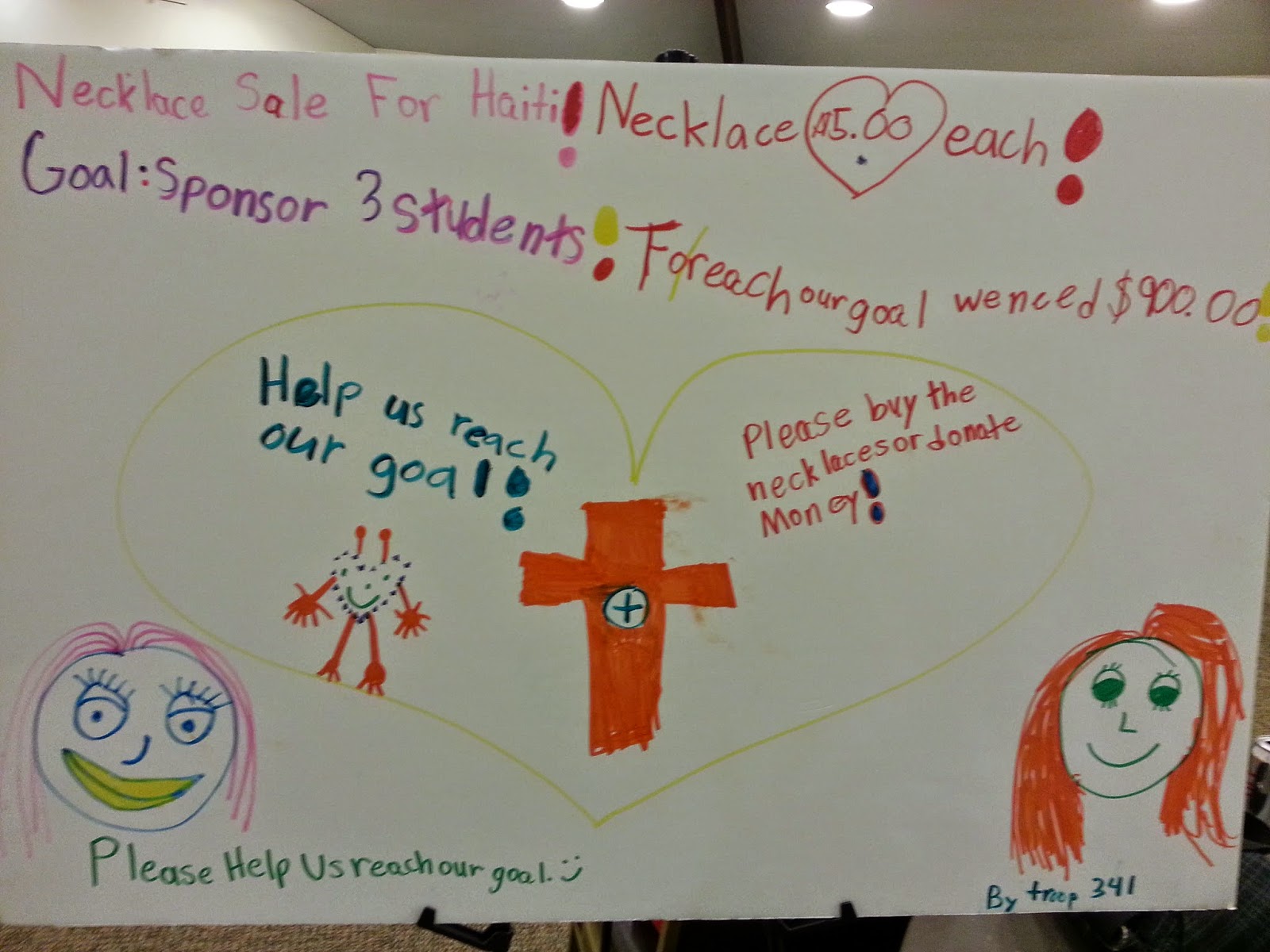
Hearts for Haiti fundraiser

It was a reach, but we hoped to sell enough necklaces to raise enough for three scholarships for students in Haiti. Our eye-opening moment: A year's tuition was a mere $300 compared to American standards. 
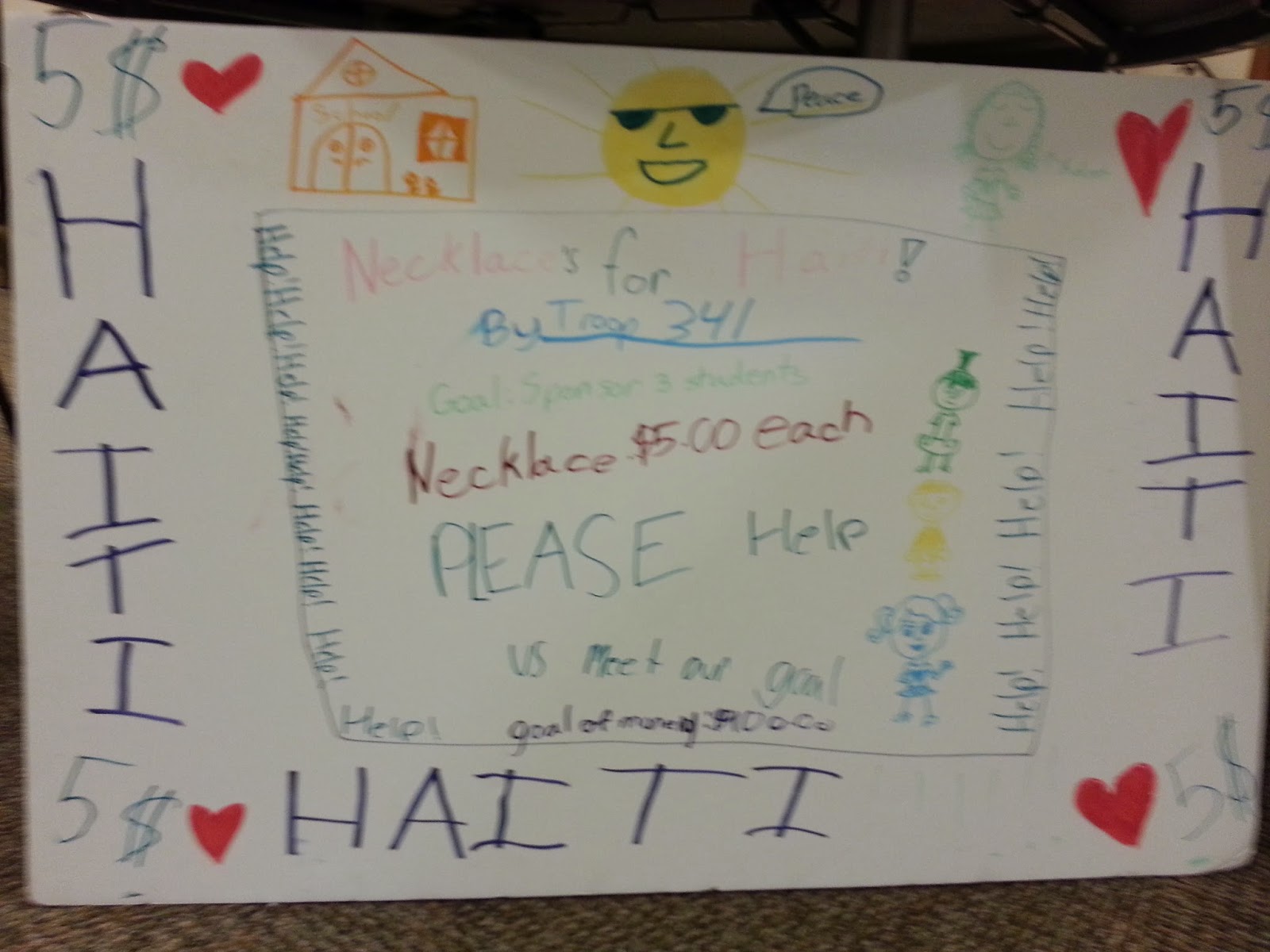
jewelry fundraiser for hearts for haiti scholarships

We didn't quite make the full three scholarships, but we were inspired. And inspired others. Tens and twenties were dropped in the donation jar and as the church service times passed, our goal reached higher....


Four services later, these girls raised more than $700 - allowing for two students to attend school worry-free for a year. We're proud. But we're even prouder of the kids in their class, when the results were announced at school, who want to something too.

Saturday, December 14, 2013

Giving and receiving: When your loved one is struggling

"To learn to give, you have to learn to receive," a sister told me years ago.


It is the toughest advice I ever had to swallow but one I think I benefit from each day.

My baby boy was just a baby, my husband was out of work, and the great recession was in its beginnings. Everyone was scared. And so was I.

This was the year that Christmas came from loved ones - and many secret Santas I'm still grateful for. They blessed us with diapers, clothes, toys for the children. I spent that Christmas day in half tears, devastated by the fact we ourselves couldn't provide things for our family. The Kroger gift card - giving us a week's worth of groceries - drove the point home. Never intended, but our situation was too raw.

I learned my "lesson" that year and despite our financial situation tucked away a few things over the year (clearance summer clothes, etc.), determined not to be empty under the tree.

But it took even longer for me to learn the real lesson. Whatever we have - no matter how little - is a gift from God, and we always have the chance to grace others and share blessings.

Here are some ways we've learned to bless others - and some tips for friends and family who are on the "other side" wanting to help:

Blessing When You're Broke

  • Time and talent: I always try to remember that in our church they talk about gifts of time, talent and treasure. (Note the treasure is last!) Gifts of time and talent can make such a difference - whether it's donating time to a charitable organization or making an upcycled gift.

    In the last few years, while we try to recover from our financial upset, we have redoubled our efforts to help, whether it's at school, scouts or church. Not only does it provide needed volunteer support, but my children will remember that mom and dad were there! Maybe you can't donate to the Angel Tree; can you help wrap gifts or deliver them?

    The gift of time is simple too. While I don't do gifts for friends, we do invite them for cookie making - treasured time when everyone is so busy! Or offer to babysit one night for a dear friend.
  • Use ExtraBucks wisely. As we don't have a lot of extra money right now, we are very careful in what we can donate. But I have recently realized that ExtraBuck deals can bless others. Now I buy nearly free diapers for our Gabriel Project at church or free foods or medications for the church food pantry. Every bit helps.
  • Reach out. I believe people naturally want to help others but sometimes we need to give them the opportunity. A woman at church knew a family whose home burnt. She certainly couldn't help them in all the ways they needed, so she reached out. And we reached out. A few phone calls later and I had not only clothes for one daughter from us but also clothes for a son and decorations for a Christmas tree I had heard was being donated to the family.

Helping Loved Ones Who are Financially Struggling

  • Don't be afraid to ask what they need...and gently encourage them to share. Do the kids need new shoes? PJs? Maybe they need diapers (or maybe cloth ones they can reuse?) or gas cards?  Be specific. Saying to let me know if you need anything, or asking what I can do to help may not get you far.
  • Help meet emotional needs. While you're not a therapist, even something as simple as movie tickets and an offer to watch the kids for a night can give parents the emotional break from the constant worry of a situation.
  • Be practical without feeling"practical." Sure you could buy groceries, but you can also buy a basket of locally made spaghetti sauces, breads and salad dressings (for example) from the winter farmers market or buy a gift certificate to a local produce delivery service. It makes the ordinary - cooking and worrying about feeding the family - feel a bit more decadent.
  • Consider experience gifts for the kids. My mother one year bought the kids soccer and dance lessons at the parks department instead of toys. She likely even saved money, but more importantly, the kids felt a little more "normal" and for once weren't turned down when they asked to do an activity.
  • Take the focus, if you can, off money. Invite them for a popcorn and Christmas movie night at your house, take them to a free or low-cost Christmas event, go caroling or looking at the Christmas lights, or invite the kids out for an afternoon of sledding.
  • Remember, while they appreciate it, it's also hard to receive. Being in a position of constant worry is difficult, and it's hard to learn to receive gracefully.

Saturday, March 17, 2012

Teamwork and tornadoes

The tornadoes that hit southern Indiana two weeks ago struck too close to home. And I don't mean geographically.
I grew up in Wichita, where tornado sirens blew twice a week in the worst of the season and you didn't really worry until the crazy weather spotters on the radio spotted something on your end of town. I remember clearly the F-5 that hit the suburb of Anderson just before my senior year and how one house, walking distance from my home, was fine, and the next looked stepped on.
I was blessed that when the F-1 hit our one-stoplight town in Kansas in 2001 that it lifted a block from my home. I still remember the train sound, the destruction, the leaves embedded in my plastic lawn chairs and siding. And I remember the little children hysterical in church the next time it stormed.
And of course the former reporter and tornado survivor (a decade ago at work) watched it all unfold on Twitter and the news. And the children were watching.
You forget how much little ones absorb, even when they're playing. So when my daughter wanted to pray for the people in Henryville two days later, I knew we had to do something. Children need to know that they can pray for results, but they also need to know they have the power to make change.
That was when we decided our Daisy Girl Scout troop needed to do something. The funny thing about tornado relief, though, is that organizations aren't equipped immediately to take things. They need food. And water. And shelter. And cleaning supplies. And, ideally, money. All of which would teach the girls nothing, and impose yet another thing for parents to buy.
Several calls and emails later, we found our answer.
Our troop would do a shoe drive, collecting outgrown shoes from our closets for Soles 4 Souls. (As my pastor put it: Kids lose their shoes on a good day!) My hope? Each family could find one pair to donate.
And then it grew. Our church's disaster committee, who I contacted for possible help in donating them, hooked us up with our pastor, who announced it during a sermon on Girl Scout Sunday. (The first-graders were thrilled!) So we made posters and collection boxes. And the word spread.
Each day, I'd tell my daughter: We have 11 more pairs. We have 20 more pairs.
Officially, our drive is over, but a few donations are trickling in. We've easily exceeded 200 pairs of shoes. More than half are going to Osgood, Indiana, with the church disaster committee this weekend. The rest are being shipped to Soles 4 Souls to help other communities in need.
It's an awesome lesson to share with our girls: By yourself you may not be able to do much, but as a team, you can accomplish a lot.

Saturday, September 17, 2011

Derail the TRAIN Act

Imagine this scene: Some maniacs have tied your children to a train track–then hopped on the train, released the brakes, and sent a mighty engine roaring down the track. Right for your children.

That’s what’s going on in Washington DC right now.

The train is, literally, the TRAIN Act of 2011, and next week, the House will vote on a bill (HR 1705) that was designed to cripple Clean Air Act regulations and intimidate the Environmental Protection Agency. The TRAIN Act requires a committee of cabinet secretaries to re-analyze the costs of public health protections. That’s right: RE-analyze. For a third time. Because when a bill is introduced, its costs are analyzed during the comment period, and again by the White House Office of Management and Budget.

Learn more about the TRAIN Act, and then write your legislators to help derail it!

Friday, June 3, 2011

The no-so-active activist me

I have my mom hat. My employee hat. My wife hat. My faith hat. My friend hat. My blogger hat. And in my mess, I probably have a few more. Do I still have room on my shelf for the activist hat?

Time is always a premium in my life. My mom schedule keeps me hopping for two hours before I walk out the door until nearly 9:30 or 10 each night, and by then,our bedtime battles leave us worn out. My husband's work schedules and our budget mean I don't have leeway for sitters to attend events or volunteer outside the home without helpers. Does that make me no longer an activist?

I'm certainly not alone. Today at the Green Phone Booth, Abbie shared her concerns about how motherwood and work often took priority over being an environmental activist.

The truth is, while I may no longer be a card-carrying member of the Sierra Club or out on a visible level, I am an environmental activist. It's just that my audience is much smaller. But much more influential.

My pint-size audience knows we recycle and reuse and whenever possible buy resale. My pint-size audience loves to enjoy nature, to hike, to check out bugs and birds. My pint-size audience reads books from the library about nature and soaks them up like a sponge.

My audience of two may be small, but they will grow. And so will their influence. And I'm OK with that.

Sunday, January 23, 2011

Regulating GE crops: Have your say

Genetically engineered crops I admit make me uneasy at best. As we don't fully know the health and environmental implications of genetically engineered food, the idea of it more fully integrating our marketplaces gives me pause.

Why does it matter now? Because the USDA is considering deregulating the use of GE alfalfa, the fourth-largest crop in the country. They are taking comments through tomorrow.

Conventional alfalfa (alfalfa that is not a GE variety and is not grown
using organic practices) has been used by farmers as livestock feed for decades
because of its high protein and low fiber content. Alfalfa ranks fourth on
the list of most widely grown crops by acreage, behind corn, soybeans, and
wheat, and is ranked third among agricultural crops in terms of value.
Because it is widespread and is typically grown as a perennial crop, alfalfa also providesimportant habitat for wildlife (Hubbard 2008). ...

Alfalfa is predominantly cross-pollinated and the flowers depend entirely on bees for cross-pollination. (USDA Environmental Impact Statement, Dec. 2010)


So what does that mean for you?
Our non-GE and organic farmers continue to be concerned with crop contamination
and market rejection. Independent studies in the U.S. and in other countries on
GE crops have documented a long list of reasons for concern, including evidence
that these crops lead to herbicide-resistant super-weeds and require the use of
more toxic herbicides. As mentioned above, organic alfalfa is used as feed by
most organic and non-GE dairies. Also, the policy set for GE alfalfa will most
likely guide policies for other GE crops as well. (Whole
Foods Blog
, Jan. 20)
On top of the cross-contamination issue, the USDA concedes that the deregulation, or increased use, would likely increase the use of herbicides such as glyphosates, but whether the use of other herbicides would increase or decrease is unknown. (USDA Environmental Impact Statemnet, Dec. 2010)

The USDA is taking comments through Monday on whether to deregulate GE alfalfa which would allow it to be planted anywhere. Alfalfa is often used as feed for dairy cows and beef cattle, and cross-contamination with GE alfalfa would have an impact on these designations.

I agre that our farmers have a right to grow foods without fear of contamination from others’ GE crops—and that consumers have a right to make the choice to buy non-GE products.
You can learn more about the alfalfa issue here.

Monday, December 14, 2009

Green journeys - Taking action

The materials of action are variable, but the use we make of them should be constant.- Epictetus (c.A.D. 50–c.A.D. 138)

“We have to join the Sierra Club,” my husband would announce once a year, cussing under his breath about the travesties George Bush would bring to the cause of the time.

And so, every 18 months or so, or whenever prodded in just the right manner, we’d concede and send off our student-rate check to join the Sierra Club. And that was that. No letter writing for causes. No joining local efforts. Just a card-carrying member.

Sure, they got our check. But they never really got our hearts.

For years, I thought I was environmentally responsible. I recycled my cans and newspapers. I turned off my lights. I combined my errands. I went to farmers markets. I even grew a few things that survived into the summer.

But I really didn’t think about it. What made the difference, though, were two little eyes looking at me. And I began to wonder what kind of world we’d leave for her. Would she have clean water to drink? Safe food to eat? Outdoors – that hadn’t been ruined by us – to enjoy?

And so, we started making more and more little changes. We cook more, and not from boxed kits or frozen packages. We actively look at the packaging we bring into our home – not to sweat over it, but to be smart about it. We try to offer more responsible in our shopping, from toys to clothes to care items. We get to know the people who help make our soaps, start our plants and grow our food.

Sure, it may not seem like a lot. I’m still not pounding the pavement to protest how endangered species are being treated or oil drilling. And once in a while, I do write a letter or two on saving the world. These days, though, I’m focusing on launching a quiet attack – by teaching my kids habits that can last for this generation and the next.

This is my submission for the December APLS Carnival on "Green Journeys." It's not too late to contribute yours - email consciousshopperblog@gmail.com by Dec. 15. And read about other bloggers' journeys on Dec. 18 at the The Conscious Shopper.

Tuesday, December 2, 2008

Mini Marathon responds on plastic situation

The 500 Festival Mini Marathon has responded to my initial e-mail regarding its plastic problem.

Ben Pawelak, the Indianapolis 500 Festivals' Ticketing and Customer Relations Coordinator, wrote to me today:

First of all, I would like to thank you for your e-mail. In moving to the D-Tag this year we considered many factors, but most of all was the overall health and safety of participants. Historically, we have seen a good number of people who faint or suffer injuries in the Mini-Marathon do so while they are waiting to have their chip removed. The switch to the D-Tag will help lessen the number of people who suffer injuries at the conclusion of the race. Rest assured that, as with all aspects of the Mini-Marathon, we will continue to monitor the D-Tag’s effect and will discuss changes for the 2010 race.

My response:
As a three-time participant in the Mini, I understand that fainting may occur at the finish line. However, attributing that solely to getting chips removed is ludicrous. Any person who has appropriately trained for a half-marathon knows they should keep moving to cool down after completing a race.
If there truly was a health issue, wouldn't the Mini Marathon organizers more appropriately design the finish line area?
Again, to be true community stewards, we need to look at all waste we generate. Proudly applauding ourselves for bottle recycling while contributing to the amount of waste we generate in our community sends an extremely mixed message.
I urge you to reconsider the use of disposable chips for future races. My children thank you.

We'll see whether I hear back.